Can Farmers Earn More Without Expanding Their Farmland?
How Integrated Farm Management and Agricultural Intensification Are Changing the Economics of Smallholder Farming.
1. The Provocative Question
When a farmer wants to double their income, the traditional reaction is to look for twice as much land. But in an era of land degradation, rising input costs, and shifting climate patterns, is expanding farmland always the smartest growth strategy—or are we simply underutilizing the acreage we already have?
2. The Problem
Conventional agriculture often relies on horizontal expansion: clearing more land, planting monocultures, and relying heavily on external chemical inputs to boost yield. This approach leads to rapid soil depletion, high capital requirements, deforestation, and extreme vulnerability to market fluctuations. When a single seasonal crop fails, the farmer’s entire annual income vanishes.
3. Why It Matters
For smallholder farmers and agribusinesses across Africa, land expansion is increasingly constrained by cost, tenure security, and environmental limits. If farm profitability remains tied solely to total surface area, rural livelihoods will plateau. We need models that maximize yield per square meter and revenue per unit of land, rather than total farm acreage.
4. The 5 Dimensions of Smart Agricultural Intensification
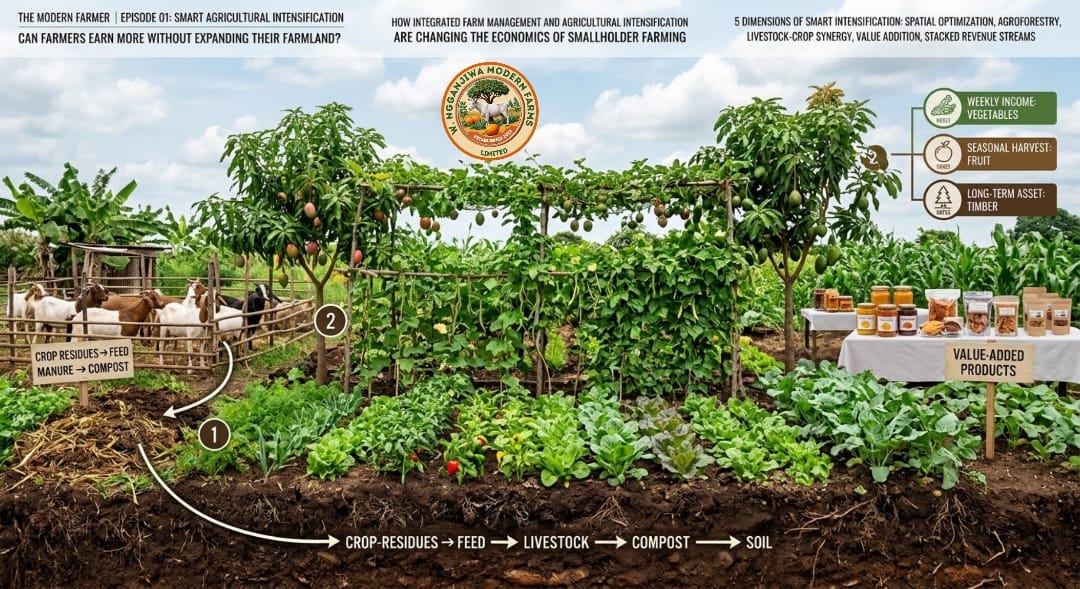
i. Spatial & Intercropping Optimization: Maximizing canopy layers and root depth by pairing complementary crops.
ii. Agroforestry Integration: Incorporating high-value timber, fruit, or soil-enriching trees to create microclimates, prevent erosion, and add long-term enterprise value.
iii. Livestock & Crop Synergy: Using crop residues for feed and returning nutrient-rich livestock manure back to the soil as organic compost.
iv. Value Addition & Processing: Moving beyond raw commodity sales by processing harvest outputs into higher-margin products.
v. Stacked Revenue Streams: Designing farms so that cash flow arrives weekly, seasonally, and long-term.
5. Practical Example on the Ground
Consider a 1-hectare plot managed under an integrated model: Layer 1 features short-cycle horticulture (such as vegetables or peppers), providing regular cash flow; Layer 2 includes climbing or trellised crops paired with fruit-bearing trees, and Layer 3 integrates livestock into a zero-waste loop—using bio-waste for feed and compost while building soil organic matter. Instead of a single annual paycheck, the farm generates multiple income streams year-round.
6. What Farmers & Agribusinesses Can Do
i. Audit Your Spatial Efficiency: Identify underutilized land boundaries, alleyways, and vertical spaces on your current plot.
ii. Map Income Cycles: Combine fast-yield short-term crops with medium-term livestock or perennial assets to distribute income across all 12 months.
iii. Prioritize Soil Organic Matter: Treat soil health as an appreciating financial asset that lowers your per-hectare input costs over time.
7. The W. Ngganjiwa Perspective
At W. Ngganjiwa Modern Farms Ltd, we are testing and refining integrated farming practices—combining livestock management, organic composting, drip irrigation, and micro-gardening. Through initiatives like our Dual Harvest Partnerships and Roots to Riches frameworks, we view intensification not as doing “more work,” but as designing smarter ecological and economic systems on the land we steward.
8. Call for Collaboration
Are you a researcher, agricultural practitioner, investor, or development partner working on sustainable land intensification? We welcome ideas, insights, and collaborative partnerships.
👉 Connect with us at W. Ngganjiwa Modern Farms Ltd to explore practical, climate-smart agribusiness models.