
Is Soil the Most Undervalued Asset on the Farm?
Unlocking Long-Term Farm Profitability Through Regenerative Soil Health.
1. The Provocative Question
Farmers often measure the value of their land by its size, its location, or its surface market price. But what if a farm’s true economic power is entirely hidden beneath its feet?
2. The Problem
For decades, modern conventional agriculture has treated soil merely as a passive physical anchor to hold plants upright, relying on synthetic fertilizers and heavy tilling to force growth. Over time, intensive tilling destroys soil structure, burns off organic matter, triggers severe erosion, and leaves fields completely dependent on escalating doses of expensive chemical inputs just to maintain baseline yields.
3. Why It Matters
When soil health degrades, input costs rise while farm resilience plummets. Crops become vulnerable to drought, root diseases, and nutrient washout. For smallholder farmers, degraded soil translates directly to declining profit margins, trapped debt cycles, and vulnerability to climate shocks. Treating soil as a living economic asset is no longer just an environmental preference—it is a strict financial necessity.
4. The 4 Dimensions of Soil Economic Health
Soil Organic Matter (SOM): Acting as the primary sponge for water and nutrients, every 1% increase in SOM dramatically boosts the soil’s water-holding capacity.
Biological Nutrient Cycling: Harnessing soil microbes, earthworms, and fungi to break down organic matter naturally, reducing reliance on synthetic fertilizers.
Erosion Control & Structure: Protecting topsoil from wind and water stripping through cover cropping, mulching, and minimum-tillage practices.
Water Retention & Drought Resilience: Enhancing soil sponge capacity so fields stay hydrated longer during erratic rainfall or dry spells.
5. Practical Example on the Ground
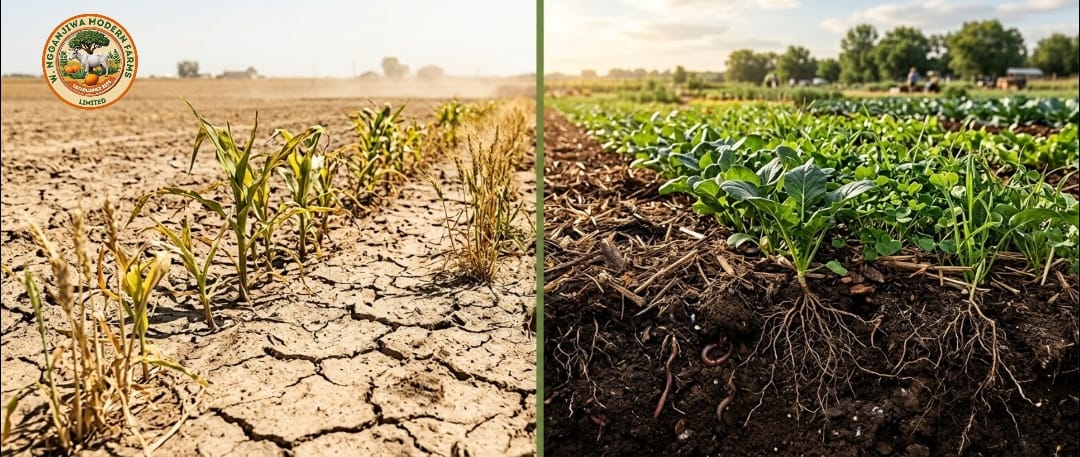
Imagine two neighboring farms facing a dry mid-season spell. Farm A relies on heavy tilling and chemical fertilizers; its soil has crusted over, causing rainwater to run off and wash away precious topsoil. Farm B practices zero-tillage, covers its soil with organic mulches, and applies decomposed livestock manure compost. Farm B’s soil retains moisture weeks longer into the dry spell, keeping crop roots alive, green, and productive while Farm A’s harvest wilts.
6. What Farmers & Agribusinesses Can Do
Stop Burning Crop Residues: Instead of clearing fields with fire, chop and incorporate residues back into the earth or convert them into organic compost.
Integrate Organic Manure: Use livestock waste (such as from goat or cattle rearing) to rebuild microbial life and soil structure.
Minimize Mechanical Tillage: Shift toward reduced-tillage or zero-tillage techniques to protect the delicate underground fungal networks that feed plant roots.
7. The W. Ngganjiwa Perspective
At W. Ngganjiwa Modern Farms Ltd, we view healthy soil as the ultimate balance sheet for a modern farm. By integrating organic composting from our livestock operations and practicing soil-retaining cultivation methods, we prove that regenerative agriculture protects the environment while directly cutting operational input costs.
8. Call for Collaboration
Are you an agronomist, soil scientist, or sustainable farming advocate partnering on land restoration? Let’s build resilient farming systems together.
👉 Connect with W. Ngganjiwa Modern Farms Ltd to share insights on regenerative soil economics.