What If Agricultural Waste Wasn’t Waste?
Turning Farm Residues into Clean Energy, Rich Compost, and New Revenue Streams.
1. The Provocative Question
Every harvest leaves behind tons of crop stalks, husks, shells, and pruning debris. Why do we treat these materials as burdensome waste to be burned or discarded when they could be the fuel and fertilizer powering our next agricultural cycle?
2. The Problem
Across rural and peri-urban farming communities, post-harvest crop residues are frequently viewed as a disposal problem. Farmers often resort to open-field burning to clear land quickly for the next planting season. This practice releases massive carbon emissions, destroys beneficial soil microorganisms, pollutes the air, and wastes billions of tons of high-potential organic matter and biomass energy.
3. Why It Matters
In a circular bioeconomy, waste is simply a resource in the wrong place. By failing to capture agricultural residues, farms miss out on dual economic opportunities: producing organic soil conditioners and generating clean alternative energy fuels (such as biomass briquettes). This waste-to-wealth transition reduces deforestation pressures caused by firewood harvesting while creating localized rural jobs.
4. The 4 Dimensions of Circular Agriculture
Nutrient Recycling (Composting): Transforming crop stubble and animal manure into high-grade organic fertilizer.
Waste-to-Energy Conversion: Densifying agricultural residues into clean-burning briquettes for domestic and industrial thermal energy.
Soil Carbon Enhancement: Returning stabilized carbon to the soil to improve moisture retention and microbial life.
Deforestation Mitigation: Providing rural households with affordable green fuel alternatives to firewood and charcoal.
5. Practical Example on the Ground
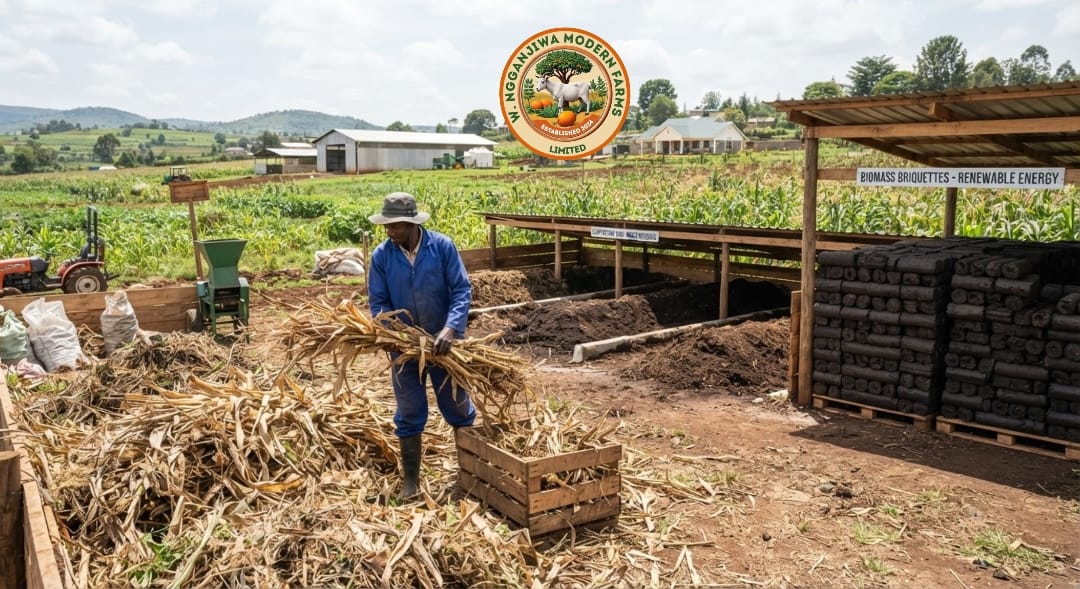
After harvesting maize, sorghum, or groundnuts, a typical farm is left with vast quantities of dry stalks and husks. Instead of burning them, an integrated circular farm gathers these residues. One fraction is shredded and composted alongside livestock manure to enrich the vegetable gardens. The remaining surplus is processed into clean-burning biomass briquettes, creating an entirely separate revenue stream while replacing wood fuel in local markets.
6. What Farmers & Agribusinesses Can Do
Audit Your Farm Residues: Calculate the volume of organic byproducts your farm generates each season.
Establish a Composting Yard: Set up a dedicated composting corner to systematically convert waste into field-ready organic fertilizer.
Explore Biomass Aggregation: Partner with local processing networks to turn agricultural leftovers into marketable clean energy products.
7. The W. Ngganjiwa Perspective
At W. Ngganjiwa Modern Farms Ltd, our operational model is built around zero-waste circular principles. From utilizing livestock manure to enrich orchard soils to processing farm residues into clean energy fuel briquettes, we demonstrate that sustainable farming closes the loop between production, energy, and environmental protection.
8. Call for Collaboration
Are you working in renewable energy, circular economies, or waste management? We invite green energy entrepreneurs and agricultural innovators to partner with us.
👉 Partner with W. Ngganjiwa Modern Farms Ltd to scale circular agriculture and clean energy solutions.